
Inventing dog games is not difficult – and there are several games hidden in almost every thing! If you want to become a sock game inventor yourself: Here are some tips to get your creativity going!
The preparation
Grab a piece of paper, a pen and preferably a sock, a stocking and/or an ankle sock – or even several of them. Try to write down at least 5 possible games that you can think of. The following tips will help!
Playing with the mould
Take a close look at the object. Observe it with an eye for detail. Turn it round and round. Think about how you can use what you have noticed. Socks, for example…
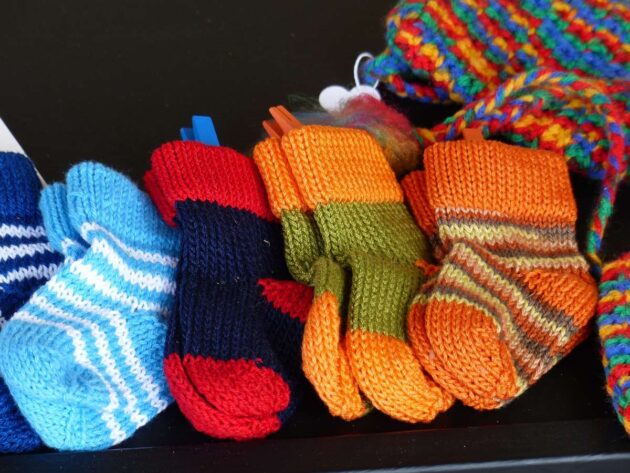
- are normally stretchy and elasticated,
- are available in short (sock), medium (normal sock length) or long (stocking),
- sometimes have holes,
- are soft and easy to cut with scissors,
- can be stuffed,
- can be knotted, rolled up, crumpled up
- is available in different colours,
- sometimes come as individual pieces, sometimes as a collection of discarded pieces,
- …
The areas of activity
If you want to do it systematically: Think your way through the different activity areas – and consider which games you can think of with one or more socks:
- Brain teasers and puzzle games (i.e. games in which the dog has to use its snout or paw to work out a mechanism in order to get a treat or toy that is out of reach at the first attempt),
- Sniffer and search games,
- Muzzle work: chewing / shredding / licking / gnawing / unwrapping,
- Gymnastics and dog gymnastics,
- Tricks.

Possible combinations
Think about the possible combinations with other items: What could the sock be filled with? Can it be a filler for something else? Where could it be pulled over? Can the sock be hung up – and does this open up new possibilities? Can it be knotted somewhere? How can several socks be joined together? And so on and so forth…
General safety tip
Please think along with us and, as always, make good use of your common sense! Please always make sure that everything is safe, especially for your dog, that he cannot swallow anything and that he is not frightened. Always consider which props and which movement sequences are really suitable for your dog!
The mnemonics
If you invent dog games, the following knowledge will help you:
- New and different = brain jogging: The brain only gets going when something is new and different from the familiar – in other words, when it cannot be processed routinely. This means that if you want to provide your dog with mental stimulation, you will have to modify the games he has already mastered from time to time. A slightly different mechanism for the puzzle game; a new way to get food by snout work; varied hiding places for nose work or unusual movement sequences for dog gymnastics or tricks – all this provides mental work!
- Everything changes quickly with dogs! The good news is that presenting things “new” and “different” to dogs is much easier than it is for us humans! This is because dogs are very detail-orientated learners. They are world champions at linking the smallest subtleties – and incredibly bad at generalising. In other words, if just one small detail changes compared to what has been learnt, this triggers at least a temporary lack of understanding (and therefore reflection). The things we moan about in everyday training are perfect for work! After all, it often only takes a tiny change and the dog has to think again – and then it’s back to mental work.
